
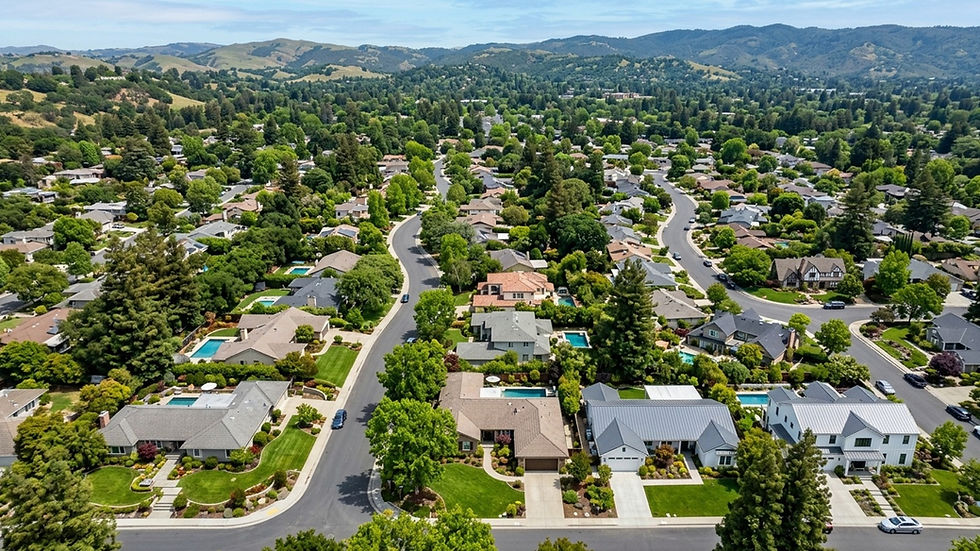
Sunnyvale, CA Real Estate & Community Guide: Buying a Home in Sunnyvale

Sunnyvale sits at the geographic center of Silicon Valley, and its housing market reflects exactly that positioning. Single-family homes here closed at a median price of $2,762,500 in May 2026, up about 2.3% from a year earlier, with most going pending in a week to ten days. Buyers who treat this as a market to browse in tend to lose out to buyers who treat it as a market to move fast in.
The city grew up around aerospace and defense work — Lockheed Martin's roots are here — and has since become home to AMD, Juniper Networks, Synopsys, and a growing slice of Apple's campus footprint along the Cupertino line. That employment base, packed into just over 22 square miles, is a big part of why demand never really lets up—and why partnering with the best real estate agent in Sunnyvale, CA is crucial for positioning homes, pricing accurately, and executing seamless transactions.
Our Proven Track Record in Sunnyvale, CA Real Estate
At Yvonne Yang Homes, we deliver strategic home transformations and market-leading results across Sunnyvale’s primary ZIP codes (94087, 94086, 94085, and 94089). Our bespoke design, renovation, and staging approach consistently maximizes ROI for Sunnyvale buyers and sellers:
Recent Sunnyvale Success Stories:
• 1129 Lexington Dr (94087): Achieved a top-dollar result, selling for $500K+ over asking price through strategic design and prep.
• 1260 Heatherstone Way (94087): Executed a complete home makeover to land a fast market win at $380K+ over asking.
• 1241 Lynn Way (94087): Strategic renovation and staging delivered a massive 4.7X ROI, selling for $320K+ over asking price.
Reading the Sunnyvale Market Right Now
Active single-family inventory hovers around 48 listings citywide - thin enough that agents describe it as roughly 0.9 months of supply. For context, six months of inventory is generally considered a balanced market. Sunnyvale isn't close to that, and hasn't been for a while. Financing needs to be locked down before you start touring, not after you've found something. With homes moving in single digits to low double digits of days, there typically isn't time to shop lenders mid-search.
Buyer's Market or Seller's Market?
Seller's market, without much ambiguity. The citywide sale-to-list ratio for single-family homes runs around 107%, and roughly 58 homes closed in a recent month against under a month of available supply. Prices on the condo and townhome side have softened more noticeably - Redfin's blended, all-property-type figure for the city was closer to $1.8 million in mid-2026, down sharply year-over-year - so the pressure is concentrated much more heavily in detached homes than in attached ones.
Who's Actually Buying Here
The buyer pool skews toward engineers and other tech employees relocating for work, plus a steady stream of move-up buyers already living in the area. Because Sunnyvale is genuinely walkable or bike-able to several major employers, commute time matters less here than in a lot of neighboring cities - which changes what buyers are willing to pay for.
Market Snapshot: The Numbers That Matter
-
Single-family median sale price: ~$2,762,500 (May 2026), +2.3% YoY
-
Condo/townhome median sale price: ~$1,373,000
-
Median days on market (SFH): 8 days
-
Sale-to-list ratio (SFH): ~107%
-
Active single-family listings: ~48 Months of supply: ~0.9
Price Trends Worth Watching
The single-family number and the citywide blended number are telling two different stories right now. Detached homes are still appreciating and moving fast; the broader market, once you fold in condos and townhomes, is showing a real correction. That gap matters for how you read headlines about Sunnyvale — "median price down 17%" and "single-family prices up" can both be technically true at the same time, describing different slices of the same market.
Supply Constraints
Forty-eight active listings across an entire city of 156,000-plus people is not much to choose from. Well-priced, updated homes in strong school zones routinely draw multiple offers within days of hitting the MLS. If you find something close to what you want, the calculus usually favors moving on it rather than continuing to look.
Where the Price Points Land
The top of the market clusters in 94087 - Serra Park & Belleville and Cherry Chase & Cumberland in particular - where homes regularly clear $3 million to $4 million on the strength of school assignments as much as square footage. Condos and townhomes, at a median around $1.37 million, are the realistic entry point for most buyers, even though "entry-level" still means seven figures here.
What You'll Actually Find on the Market
Sunnyvale's housing stock leans heavily toward mid-century construction - it has one of the better concentrations of Eichler homes in the Bay Area - alongside postwar ranch houses and a growing number of newer townhome and condo projects clustered near downtown and the Caltrain line. Detached homes carry most of the dollar volume in the market even though condos and townhomes make up a larger share of what's actively listed.
Setback rules, second-story addition limits, and lot coverage restrictions vary by neighborhood and sometimes by tract, so it's worth checking zoning before you get attached to a remodel plan.
Single-Family Houses
This is where the competition lives. Eichlers and mid-century ranches in strong school boundaries are the properties most likely to draw multiple offers, and they're the main reason the citywide sale-to-list ratio sits above 107%.
New Builds and Teardowns
Genuinely new single-family construction is scarce — there's not enough vacant land left for it. What you'll see instead is teardown-rebuild activity: an older home purchased primarily for its lot, then replaced with something modern. Those rebuilds tend to list well above whatever the surrounding older homes are selling for.
Condos and Townhomes
This is the segment with room to breathe. More inventory, longer average time on market, and a median price roughly half that of a single-family home. Downtown and the 94089 corridor near the Baylands are where most of this product sits. Budget for HOA dues on top of the mortgage before you run your numbers
A Neighborhood-to-Neighborhood Look
Sunnyvale is split into four residential ZIP codes, and each one behaves like something close to its own micro-market. School assignment, more than ZIP code alone, tends to be the biggest swing factor in price - and boundaries don't always follow ZIP lines cleanly.
94087: The Premium Zone
South of El Camino Real, 94087 is the largest and most expensive of the four. Serra Park & Belleville and Cherry Chase & Cumberland sit at the top of the price range, largely because of their school assignments. Birdland and Raynor Park, also in this ZIP, hold a real concentration of Eichler homes - post-and-beam construction, glass walls, the whole mid-century package.
94086: Downtown and the Heritage District
Central Sunnyvale, home to Murphy Avenue, the Heritage District, and the Caltrain station. This is the most walkable part of the city by a wide margin, which draws a different kind of buyer than the more suburban southern ZIPs - people prioritizing car-free days over square footage. Washington Park, at the western edge near Mountain View, and Ponderosa Park, closer to Santa Clara Unified boundaries, round out this ZIP's smaller pockets.
94085 and 94089: More Accessible Entry Points
94085, tucked between Highway 101 and Central Expressway, tends to price a step below 94086 and 94087. 94089, north of the freeway, includes Lakewood Village and sits closest to the Baylands and NASA Ames - it's also where you'll find most of the newer condo and townhome construction, along with a handful of mobile home parks that keep the ZIP's overall price point lower than the rest of the city.
Geography, County, and How People Get Around
Sunnyvale is in Santa Clara County and falls under the San Jose-Sunnyvale-Santa Clara metro designation, with San Jose itself just a few miles south. Highway 101 and Central Expressway carry most of the car traffic, while Caltrain runs straight through downtown for anyone commuting north toward San Francisco or south toward San Jose. VTA bus lines fill in the gaps.
Property taxes run through Santa Clara County regardless of which of the four ZIP codes a home sits in, so county-level assessment rules apply uniformly across the city.
County and Metro Ties
Santa Clara County is one of the highest-income regions in the country, and being located here has real implications for property taxes - they're assessed at the county level. Proximity to San Jose means residents can access the broader metro area's amenities without living in the middle of it.
ZIP Codes and Mail
Palo Alto has seven ZIP codes assigned by the USPS. The primary standard ZIP codes are 94301, 94303, 94304, and 94306. The postal service uses 94302 and 94309 for PO Box addresses only.
Airports and Transportation
Norman Y. Mineta San Jose International Airport (SJC) is the closest option, about 7 to 10 miles away and roughly a 13-to-14-minute drive without traffic. San Francisco International (SFO) is the better choice for international travel, at around 29 miles north. Moffett Federal Airfield, just north of the city near 94089, houses NASA Ames and isn't a commercial option, but it's a notable neighbor.
Sunnyvale is conveniently located alongside the Bay Area's extensive Caltrain network, connecting to other Silicon Valley transit networks like VTA, Light Rail, or BART.
Cost of Living, Demographics, and Lifestyle
Sunnyvale's population runs around 156,600. Median household income sits near $186,170, with average annual household income closer to $254,735 - a gap that reflects a fairly wide income spread even within a generally high-earning city.
At a $2.76 million single-family median, most buyers are stretching well past the median household income to qualify, particularly once jumbo loan underwriting standards come into play. This isn't a market where the "typical" household income buys the "typical" home without a second earner or significant existing equity.
Local Climate
The climate leans Mediterranean - around 300 sunny days a year, dry summers in the 70s and 80s, mild winters, and roughly 17 inches of rain concentrated between December and March. It's a genuine reason outdoor living space shows up so often on buyers' must-have lists.
Finding a Real Estate Agent in Sunnyvale, CA
Working with the best real estate agent in Sunnyvale isn't just helpful — it's important in a market where neighborhood, school assignment, property condition, and pricing can make a meaningful difference.
A local Sunnyvale real estate professional understands how buyers compare homes across neighborhoods, what specific properties are actually selling for, and how to position a home against competing listings. They can also help you navigate inspections, disclosures, negotiations, and the many details involved in a California real estate transaction.
Whether you're buying your first Sunnyvale home, moving within Silicon Valley, or preparing to sell, you want someone who understands the market beyond the citywide statistics.
How to Choose a Local Real Estate Agent
Look for an agent who has recently represented buyers and sellers in Sunnyvale and can speak confidently about the neighborhoods and property types you're considering.
Ask about their experience in areas such as Cherry Chase, Sunnyvale West, Ponderosa Park, Lakewood, East Sunnyvale, and Downtown Sunnyvale, and how buyer demand can vary from one neighborhood to another.
A strong local agent should also be able to explain:
-
How recent comparable sales affect your home's value
-
Which improvements may help before selling
-
How to evaluate a home's renovation potential
-
How to approach multiple-offer situations
-
How to structure a competitive offer
-
How current inventory and buyer demand may affect your timing
Experience matters, but so does the ability to turn that experience into a clear strategy for your specific property or search.
Commissions and Interview Questions
Real estate compensation should be discussed clearly before you enter into a representation agreement. Ask each agent to explain their services, compensation structure, and what is included so you can make an informed comparison.
Then ask the questions that reveal how they actually work:
-
How do you determine the right price for a Sunnyvale home?
-
What improvements would you recommend before I sell — and which ones would you avoid?
-
How do you help buyers compete when multiple offers are expected?
-
How do you identify opportunities that aren't obvious from the MLS listing?
-
Who manages the renovation, staging, marketing, and other preparation if my home needs work before going on the market?
The answers can tell you whether you're working with someone who simply facilitates transactions or a real estate professional who understands how to position, negotiate, and manage the entire process.
For buyers and sellers in Sunnyvale, that distinction can make a meaningful difference.
Frequently Asked Questions
Do I need an all-cash offer to successfully buy a house in Sunnyvale?
No. Cash offers appeal to sellers because they remove financing risk, but plenty of buyers win with fully underwritten jumbo loans. The key is having your financing locked down before you bid, not scrambling once you're in contract.
Does buying in Sunnyvale guarantee a specific school district?
No - and this trips people up. School boundaries cut across ZIP codes here. A given address might fall under Sunnyvale School District, Santa Clara Unified, or Cupertino Union for elementary and middle school, with Fremont Union High School District handling most high schools regardless. Always verify the specific address, not just the ZIP code.
What happens if the Sunnyvale home I want to buy is located in a designated flood zone?
Lenders will require flood insurance if the property falls in a designated flood zone, which is more common toward the Baylands and the eastern part of the city. Get an insurance quote during your inspection period so the ongoing cost isn't a surprise after closing.
What does it take to qualify for a jumbo loan here?
Expect to need at least 10% to 20% down, strong credit, and income documentation that supports the loan size — at a $2.76 million single-family median, that's a meaningfully larger loan than a conforming mortgage covers.
How long does the home buying process usually take in the competitive Sunnyvale market?
Single-family homes average about 8 to 13 days on market before going pending. Once you're in contract, escrow typically runs 21 to 30 days, so a fast-moving purchase can close in under six weeks total.
How does buying a home in Sunnyvale compare to neighboring cities like Cupertino or Mountain View?
The underlying dynamic - tight supply, fast sales, prices well above the national average — is similar across all three cities. What sets Sunnyvale apart is its four-ZIP structure, its unusually deep concentration of Eichler homes, and a location that puts it within easy reach of more major employers than either neighboring city.